Manuscript under review, the paper link and code repository will be finalized upon publication.
Abstract
DeepDOSReasoner predicts a material's electronic and phonon density of states (eDOS and phDOS) directly from its crystal structure, the spectra that govern electronic, optical, vibrational, and thermal behavior, and that normally require costly density functional theory (DFT). It couples a structure-aware neural decoder, which grounds each energy bin in the atoms that contribute at that energy via atom-to-energy source attention, with a physics-grounded reasoning stage that refines the spectrum under a continuity-equation transport enforcing non-negativity and total-state conservation by construction. The result sets a new state of the art across eDOS and phDOS benchmarks while running roughly 107× faster than DFT (~10.5 ms per crystal). It outperforms every prior crystal-to-spectrum model on all major metrics, raising the eDOS R2 from 0.645 to 0.691, cutting the eDOS Wasserstein distance by 14.3%, and improving the phDOS R2 by 15%, while recovering sharp band edges and rare near-Fermi gaps. It is also remarkably sample-efficient, matching those strong baselines with only 25% of the training data and staying accurate in the low-data regime where prior crystal-to-spectrum models break down, which makes it well-suited to new spectrum-prediction tasks with little labeled data.
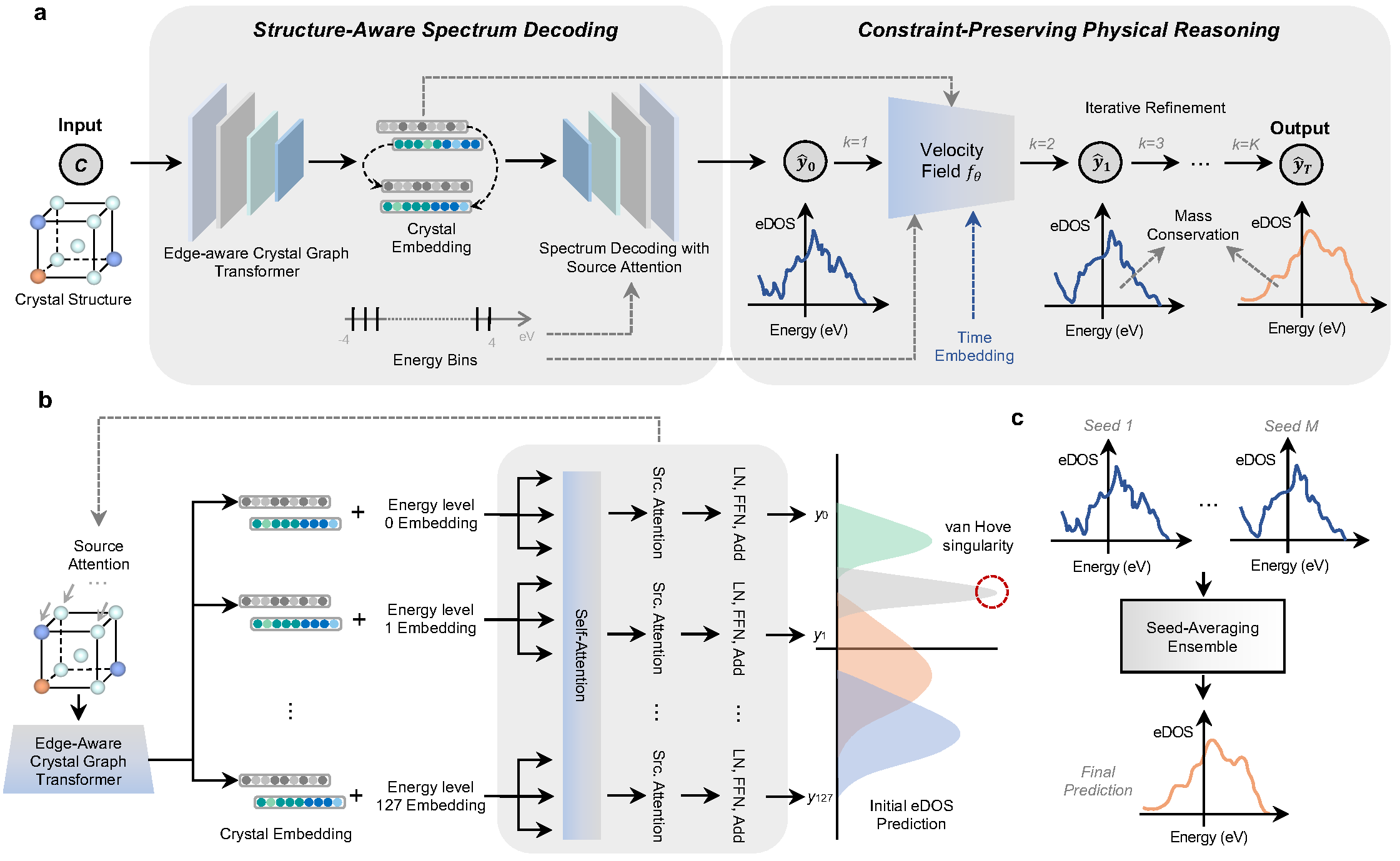
Figure 1 — DeepDOSReasoner architecture. (a) The two coupled stages: structure-aware spectrum decoding, then constraint-preserving physical reasoning that iteratively refines the spectrum under a mass-conserving transport. (b) The source-attention decoder — each energy-bin query attends over the atom-level embeddings. (c) The seed-averaging ensemble used at inference.
At a glance
↓13.3%eDOS prediction (MSE vs. best baseline)
↓20%phDOS prediction (MSE vs. best baseline)
0.904VB-gap identification (precision)
+18.6%VB-gap discovery (MCC vs. best baseline)
~107×faster than DFT (~10.5 ms / crystal)
~25%of training data to beat the strongest baseline
How it works
DeepDOSReasoner couples a structure-aware neural decoder with a physics-grounded reasoning stage. The shape of the spectrum is learned from data; its total magnitude is fixed by chemistry, and conservation is guaranteed by the integrator itself rather than encouraged by a soft penalty.
Stage I
Structure-aware spectrum decoding
An edge-aware crystal-graph Transformer encodes atoms and interatomic features. A decoder then produces the spectrum bin-by-bin through atom-to-energy source attention: each energy bin selectively aggregates atom-level information, grounding every spectral coordinate in the atoms that physically contribute at that energy — and recovering element-resolved contributions with no explicit supervision.
Stage II
Constraint-preserving physical reasoning
The normalized DOS is treated as a probability density and refined by a learned continuity-equation transport with no-flux boundaries. A CDF-based upwind scheme moves spectral mass along the energy axis while keeping the spectrum non-negative and conserving total states by construction. Mass can only be redistributed — never created or destroyed — so the output is a valid density at every step.
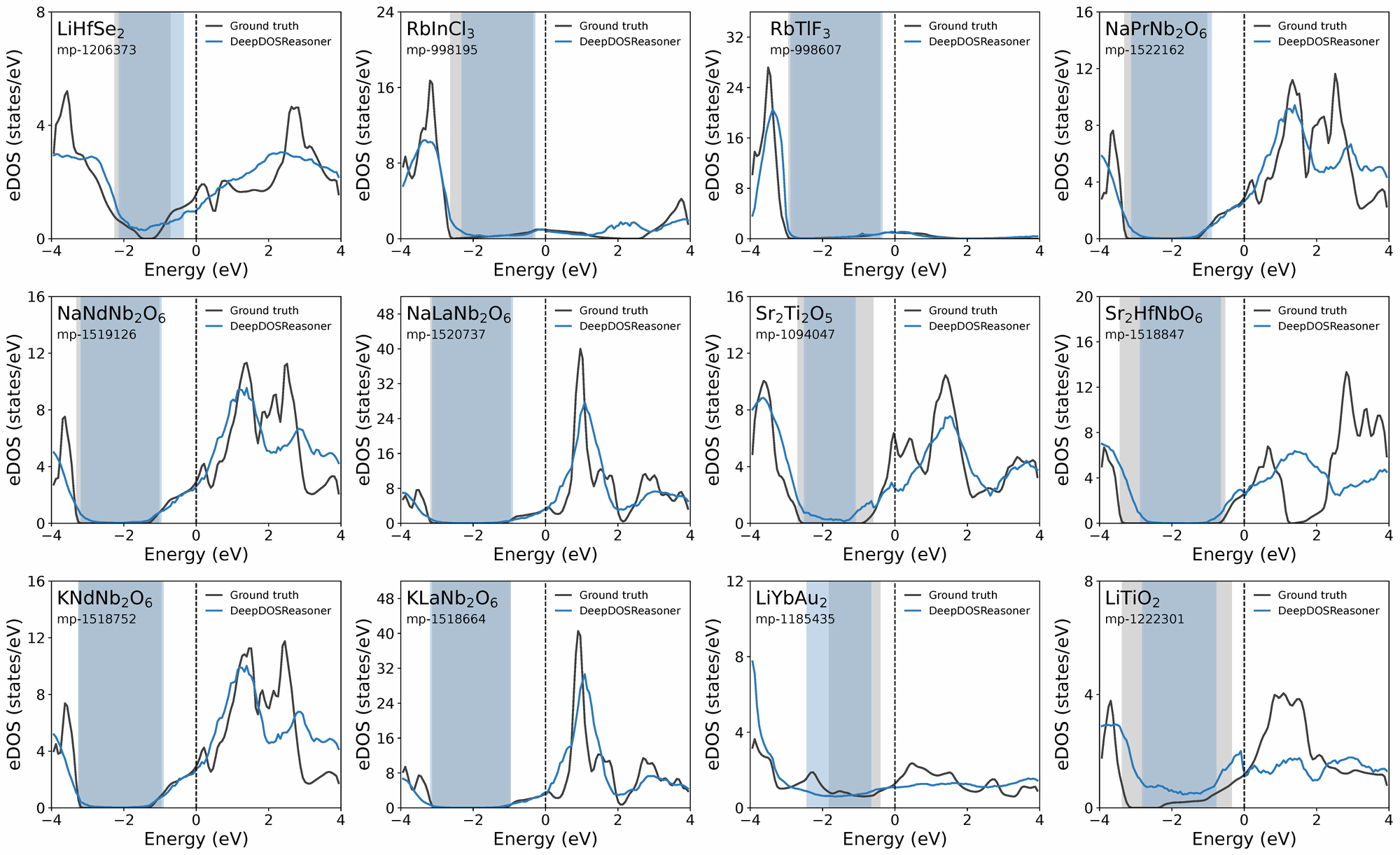
Why the reasoning stage matters. Predicted eDOS (blue) vs. DFT (grey) for twelve out-of-distribution candidates flagged in a valence-band-gap discovery screen. The constraint-preserving reasoning stage keeps band edges sharp and reproduces the rare suppressed-density windows just below the Fermi level (shaded) — the near-Fermi valence-band gaps that pointwise-regression baselines blur away — on compositions the model never saw labeled.
Interactive demo
Explore real DeepDOSReasoner predictions against DFT ground truth — across the electronic- and phonon-DOS benchmarks (with the Mat2Spec and DOSTransformer baselines) and three paper case studies. Click a legend entry to toggle a curve, hover for values, and pick any material from the list. Each benchmark entry also shows its crystal structure in an interactive 3D viewer beside the spectrum.
—
MSE is computed per material against the DFT label over the plotted window. The Electronic- and Phonon-DOS tabs are the primary benchmarks and also show the Mat2Spec and DOSTransformer baselines. Semiconductors (seven Cu2BaMX4 chalcogenides), the CuPtFeCoNi High-entropy alloy, and the Ga-for-In substituted Doped materials are paper case studies, each comparing DeepDOSReasoner against DFT.
Try it on your structure
Upload a crystal structure (CIF or VASP POSCAR/CONTCAR) and get its predicted electronic DOS from DeepDOSReasoner. Files are sent to the inference service for prediction and are not stored.